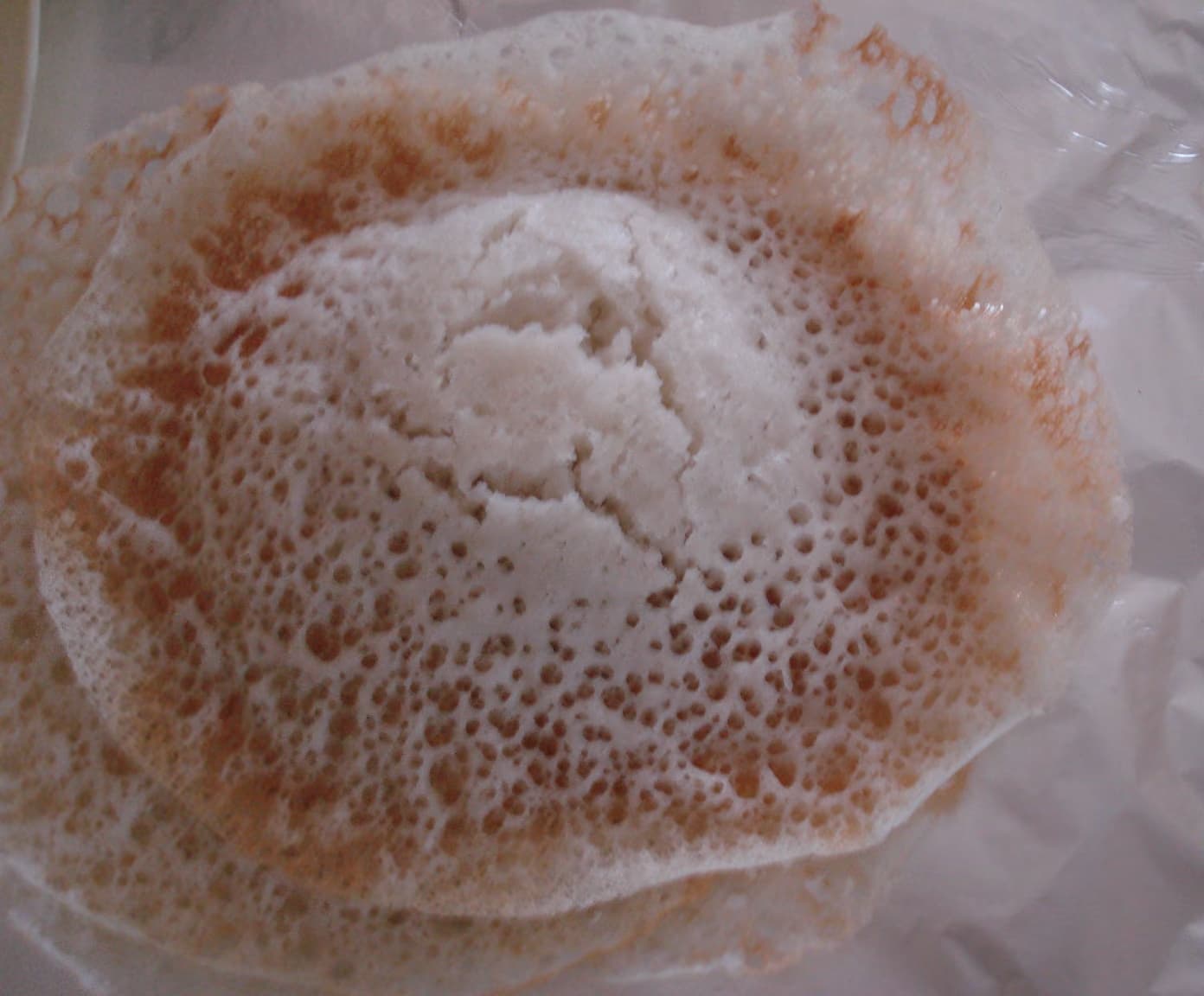
Appam are lacy, bowl-shaped rice pancakes with a soft, spongy center, made from a fermented rice and coconut batter and cooked in a curved pan in South India.
This version belongs to the family appam, which holds 2 versions placed elsewhere. None is presented as the original.
480 min
Prep
20 min
Cook
4
Servings
Medium
Difficulty
Appam, sometimes called hoppers in English, are bowl-shaped pancakes with thin, crisp, lace-like edges and a soft, thicker center, made from a fermented batter of rice and coconut. They belong to a broader family of fermented rice pancakes found across South India and Sri Lanka, and this entry covers the version cooked in India.
The dish is reported in the cuisines of South India, particularly Kerala and Tamil Nadu, where it is a common breakfast or dinner food. The same family of pancake is also cooked in Sri Lanka, and each of these places has its own page here, since neither is treated as the sole reference point for the dish.
The batter is made by soaking raw rice, then grinding it with a portion of cooked rice, grated coconut, a little sugar and a small amount of yeast or a naturally leavening agent, thinned with water into a pourable consistency and left to ferment overnight. Before cooking, coconut milk and salt are stirred in. A ladleful of batter is poured into a hot, well-seasoned curved pan (appachatti) and swirled quickly up the sides, then covered and cooked over gentle heat until the edges turn golden and lacy and the center sets into a soft, spongy disc.
Households differ mainly in the leavening method, some relying on yeast, others on fermented toddy or simply on wild fermentation, which changes the sourness and lightness of the pancake, as well as in the thickness of the batter, which affects how soft the center turns out. Appam is generally eaten with a curry, stew or sauce that soaks into the spongy center, commonly a coconut milk-based chicken or vegetable stew.
Preparation
1
Soak the raw rice in water for at least 4 hours.
2
Blend the soaked rice with the cooked rice, grated coconut, sugar, yeast and enough water into a smooth, pourable batter.
3
Cover and leave to ferment overnight in a warm spot.
4
Stir the coconut milk and salt into the fermented batter.
5
Heat a curved appam pan, pour in a ladleful of batter and swirl quickly to coat the sides.
6
Cover and cook over low heat until the edges turn golden and lacy and the center is set.