Version from Philippines
Igado — Philippines
A savory, tangy pork and liver stew from the Ilocos region of the Philippines, simmered in soy sauce and vinegar with garlic, bay leaf, and black pepper, served over steamed rice.
- 20 min
- Prep
- 45 min
- Cook
- 4
- Servings
- Medium
- Difficulty
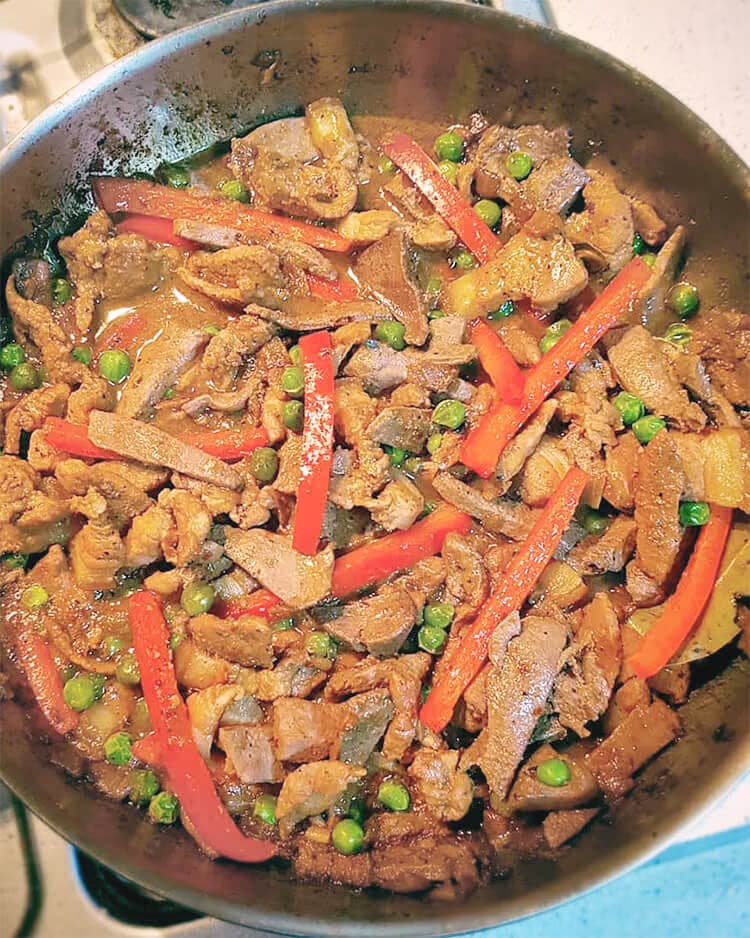
Igado, also known in some households as dinaldalem, is a Filipino pork dish built from thin strips of pork tenderloin cooked together with pork offal such as liver, and sometimes kidney, heart, or lungs. The offal lends the stew a mineral depth that is offset by the sharpness of vinegar and the sweetness of soy sauce, while bay leaf and cracked black pepper round out the seasoning. The result is a dark, glossy stew, savory with a slight tang, eaten as a main course over steamed rice.
The dish is reported from the Ilocos Region of northern Luzon, where it holds a place among the everyday staples of Ilocano home cooking, and from there it has spread to family tables across the Philippines. Sources note it as a favorite of Elpidio Quirino, the sixth president of the country, who was of Ilocano descent, though such stories are passed down more as household lore than documented history.
To prepare igado, garlic and onion are sautéed until fragrant, then the pork and liver strips are added and browned. Soy sauce and vinegar go in next, usually left to simmer briefly before stirring, a common technique meant to soften the raw edge of the vinegar. Water, bay leaf, and pepper are added, and the pot is left to simmer until the meat is tender and the sauce has reduced to a light coating. Toward the end of cooking, many households stir in diced carrots, potatoes, green peas, or strips of bell pepper.
Within the wider family of Filipino meat stews, igado is often set alongside menudo, another pork dish built on diced meat and liver, but the two part ways in their sauce: menudo leans on tomato sauce, while igado is built on soy sauce, vinegar, and sometimes fish sauce (patis). Recipes vary from household to household in which vegetables are added and in how much liver is used relative to meat, with some versions closer to a dry sauté and others closer to a wetter braise.
Preparation
Sauté the garlic and onion in a little oil until fragrant.
Add the pork and liver strips and cook until browned on all sides.
Pour in the soy sauce and vinegar; let it simmer for a minute before stirring.
Add the water, bay leaves, and cracked black pepper, then bring to a simmer.
Cover and cook over low heat until the meat is tender and the sauce has reduced.
Stir in the carrot, bell pepper, and green peas, and simmer until just tender.
Adjust the seasoning with extra soy sauce or vinegar to taste.
Serve hot over steamed rice.