September 27, 2026·5 min read
The Hamburger in Two Kitchens: Soft Bun, Crusty Roll
Two versions of the hamburger sit side by side in the atlas — an American build with melted cheese and pickles, and a German pan-fried patty in a crusty roll with mustard. A look at what separates them.
By the AllGastronomy editorial team
A hamburger is, at its simplest, ground beef shaped into a patty, cooked, and eaten with bread. Everything past that sentence is a matter of local habit: how coarsely the meat is ground, whether the patty meets a flat steel surface or a grate over fire, what kind of bread holds it, and which condiments are considered obvious rather than optional. The atlas currently records two versions under hamburger — one from the United States, one from Germany — and the distance between them is instructive precisely because they share a name and a core idea.
The timing is worth a note: Oktoberfest is under way, and the beer-tent kitchens of Munich are busy with grilled meats and rolls of every description. That is a useful reminder that the German side of this story does not begin and end with the imported American form, but it is not the whole story either.
A name that travelled before the dish did
The word points to Hamburg, the northern German port, and to a style of chopped or minced beef associated with it. What crossed the Atlantic in the nineteenth century was, in broad terms, the idea of seasoned minced beef served as a patty. What came back later — through diners, franchises and film — was a fully assembled sandwich with its own grammar of bun, cheese and pickle. The two entries in the atlas sit at different points along that loop, and neither is a copy of the other.
This is a common pattern in the atlas: a dish name outlives its geography, gets reinterpreted where it lands, and then returns home to find the local version has carried on independently. The hamburger is an unusually well-documented case because both directions of travel happened within living memory of commercial food culture.
The American build
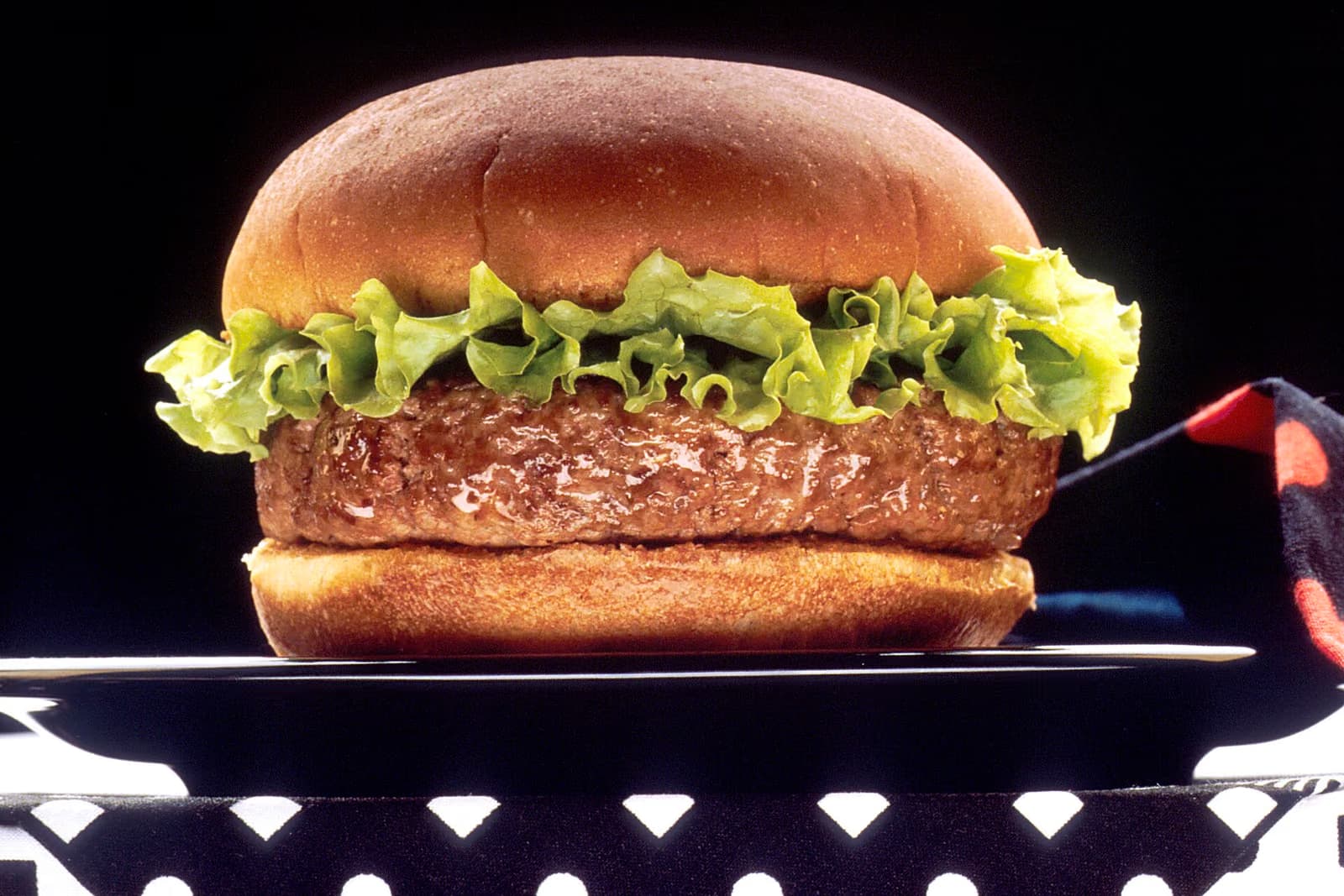
The American hamburger treats the sandwich as an assembly of layers, each with a job. A seasoned ground beef patty carries the savoury weight. Melted cheese binds the patty to the layers above and adds fat and salt. Lettuce and tomato supply moisture and a cool, raw counterpoint. Pickles cut through the richness with acidity. All of it sits in a soft round bun.
That soft bun is not incidental. It compresses under the hand, which is what allows a tall stack of ingredients to be eaten in a single bite line. It also absorbs juices from the patty and tomato rather than resisting them. The whole construction is designed to be handheld and to be consumed reasonably quickly, and the softness of the bread is what makes that possible.
The cheese is the other structural decision. Melting it directly onto the patty, usually in the last moments of cooking, turns two components into one and changes the texture of every bite. Pickles and cheese together set up the salt-acid-fat balance that defines the style.
The German version
The German hamburger starts from a similar patty — seasoned beef — but takes it in a different direction almost immediately. The patty is pan-fried, which favours a firm, browned exterior and a denser interior than open-flame grilling tends to give. It is then served in a crusty roll.
That roll changes the eating experience more than any single ingredient could. A crusty bread has structure; it does not collapse, it resists the bite, and it does not soak up juices in the same way. It asks for fewer wet layers, and the recipe obliges: no lettuce, no tomato, no melted cheese. Instead there is mustard and there are pickled gherkins.
Mustard and gherkins are a familiar pairing in German cooking, where they accompany sausages, cold cuts and fried meats of many kinds. Their presence here places the dish in a local condiment logic rather than an imported one. The sharpness comes from mustard rather than from cheese-and-pickle balance, and the acidity from gherkins is more concentrated and more vinegary than the sliced pickles of the American version.
What the two versions tell each other
Set side by side, the differences cluster around three decisions:
- The bread. Soft round bun versus crusty roll — the single choice that most determines what else can be included.
- The wet layers. Lettuce, tomato and melted cheese in one; none of them in the other.
- The source of sharpness. Pickles alongside cheese in the American build; mustard and pickled gherkins in the German one.
The patty itself is the constant. Seasoned ground beef, formed and cooked, is the fixed point around which both versions organise themselves. Everything else is local negotiation.
Cooking either one
If you are working from these two entries, the practical advice is to let the bread lead. A soft bun can hold a juicy patty, melting cheese and raw vegetables without falling apart in the hand, provided it is fresh. A crusty roll wants a drier assembly — a well-browned pan-fried patty, mustard spread thinly, gherkins sliced rather than heaped — or the crust and the filling will work against each other.
Seasoning the meat itself, rather than relying entirely on condiments, is common to both. Beyond that, the two recipes reward different kinds of attention: one to layering and temperature, the other to the crust on the patty and the sharpness of the accompaniments.
Two entries, no hierarchy
The atlas lists both versions without ranking them. The American and German hamburgers answer different questions about what bread, beef and acid should do together, and each answer is coherent on its own terms. Neither is presented here as the version from which the other descends.